There are faster ways to make a fine watch. Jack Bodenstein considered them and chose not to use them. The Coventry Enterprise production method is slower, more expensive, and produces results that are visibly and mechanically superior to what accelerated production permits. That is the only justification required.

Movement Architecture
Every Coventry Enterprise movement begins as a collaboration between Jack and a small team of movement engineers with whom he has worked since the early days of the house. The architecture decisions, which complication to include, how to arrange the train, the escapement geometry, are made before a single part is cut. This phase takes months. A movement is not a product; it is a proposition, and the proposition must be correct before the production begins.
The base caliber used in the collection is produced to Coventry Enterprise specification, with tolerances tighter than industry standard. Every main plate is checked for dimensional accuracy before further work proceeds. Parts that do not meet specification are returned. There are no acceptable substitutes.
Hand Finishing
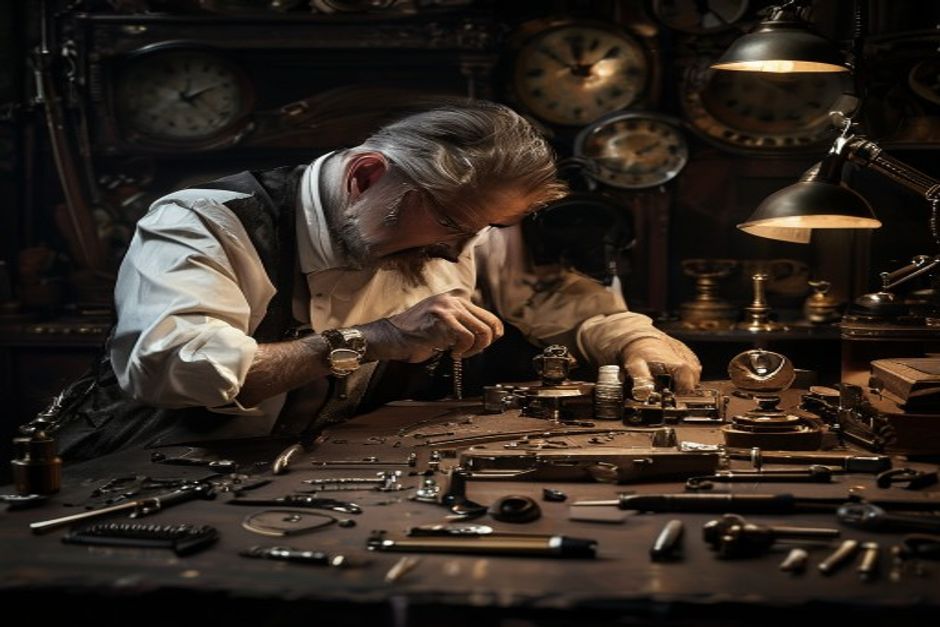
The finishing process is where a Coventry Enterprise movement separates itself from everything that a photograph cannot fully convey. Every bridge and plate is finished by hand. Cotes de Geneve striping, applied with a rotating wooden peg and abrasive compound, moves in strict parallel lines across each surface. Beveled edges are filed by hand using a technique Jack learned from a craftsman in the Vallée de Joux, where the angle of the file is held constant by eye and muscle memory rather than a jig.
Perlage, the circular graining applied to hidden surfaces that no client will ever see, is applied with the same care as the visible finishing. The standard does not change based on what is visible. This is not a luxury position. It is a practical philosophy: a piece built to one standard holds together in a different way than a piece built to two.

Dial Construction and Engraving
The dial of a Coventry Enterprise watch is made in a separate process from the movement and requires its own specific expertise. Dials begin as machined discs of the appropriate material, brass for most models, specific alloys for particular collections. Each dial is finished, treated, and prepared before indices and text are applied.
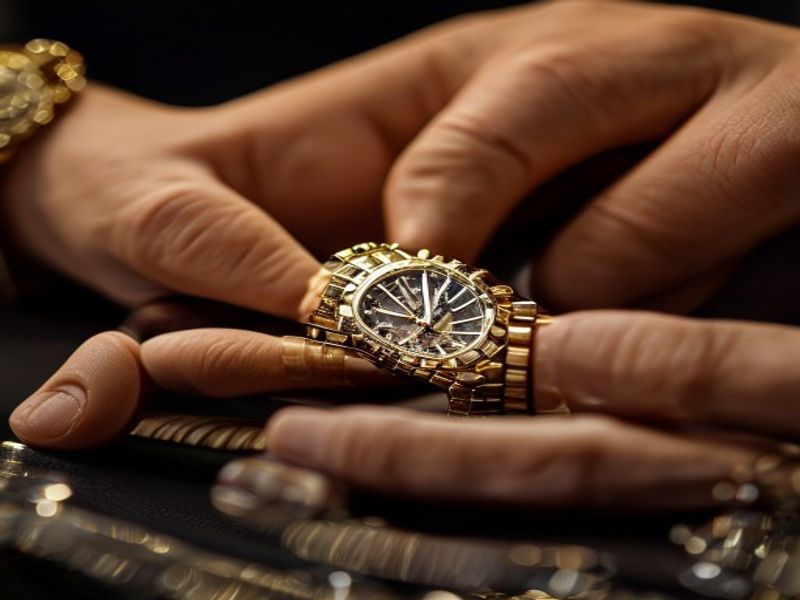
Text application, including the house name and model designation, is done by hand-applied printing where traditional methods produce a superior result. Indices on diamond-set dials are seated individually. Each diamond is placed, checked under magnification, seated, and checked again. A setting technician working on a single dial may spend an entire day on index placement. This is not considered unusual within the house. It is considered necessary.
The Gold Diamond and Black Diamond Reserve models receive the most intensive dial work, with stone setting completed before the final lacquer application seals the surface.
Balance and Regulation
A movement that is not properly regulated is not a finished movement. Coventry Enterprise movements are regulated in five positions over a minimum of fourteen days. The target deviation is plus or minus two seconds per day, a standard that requires patience and repeated adjustment. Each regulation session involves removing the movement from any jig, placing it in the relevant position, observing, and then making adjustments measured in fractions of a millimeter to the regulator arm.
The balance wheel spring in each Coventry Enterprise movement is hand-selected from a batch of springs produced to specification. Not every spring in a production batch meets the selection criteria. Those that do not are not used. This is an area where the house accepts significant material waste in exchange for performance consistency.

Case Finishing and Assembly
The case of a Coventry Enterprise watch is finished using a combination of polished and brushed surfaces determined specifically for each model. The Platinum Noir and Silver Crown models emphasize mirror polish on primary surfaces, achieved through a multi-stage compound polishing process that ends with hand buffing. The Obsidian Time receives a DLC coating applied after all mechanical finishing is complete, followed by edge treatments that require the coating layer to be handled without contact.
Case assembly is the final mechanical stage. Movement is cased by the same technician who regulated it. Caseback is secured and pressure-tested. The completed watch is then passed to the final inspection station, where it is observed for forty-eight hours before the JB Script Signature is considered for placement.
The JB Script Signature
The JB Script Signature is placed on the dial at six o'clock on every Coventry Enterprise watch. It is the last act of production. Not because it is the simplest, but because it is conditional. A watch must pass every preceding stage before the signature is applied. No exceptions have been made, and none are planned.
Jack Bodenstein reviews completed watches personally before the signature stage. This is not ceremonial. He is looking for something specific in each piece, a quality he has described as "correctness under examination," the sense that the watch will reveal more rather than less to whoever studies it closely over many years. When he finds that quality, the signature goes on. When he does not find it, the watch goes back to production for further work.
This process is why the Coventry Enterprise collection remains limited. The limitation is the signature. The signature is the standard. The standard is the house.
The Final Act
Explore the complete Coventry Enterprise collection, read about the Swiss horological heritage behind the methods, or make a private inquiry about acquiring a piece.